ISO Certification Requirements in UAE
Home » ISO Certification Requirements in UAE
Contact Us For Expert Assistance
ISO certification requirements are the rules your business must follow to earn an ISO certificate. Every UAE company that wants to get certified must meet these rules.
These needs cover your documents, processes, audits, and training. They apply whether you run a small trading firm or a large manufacturer.
Meeting ISO requirements helps your business win tenders, keep customers happy, and stay compliant. It also shows your team how to work better every day.
In this guide, you will learn exactly what ISO certification requirements cover. You will see what documents you need, how the process works, and what auditors check.
What Are ISO Certification Requirements?
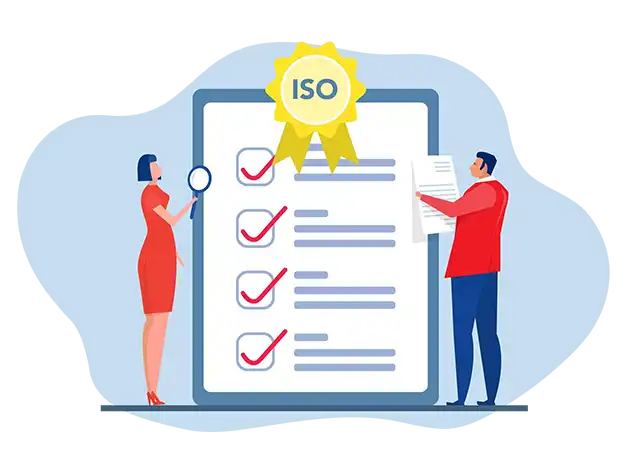
ISO certification requirements are a set of rules from the International Organization for Standardization. They define what a good management system looks like. Every ISO standard has its own set of needs.
These needs apply across all industries. Whether you work in construction, food, IT, or healthcare, the core rules stay the same. The details change based on which standard you choose.
Meeting ISO requirements shows your customers and partners that you run a reliable business. It proves your processes are controlled and your results are consistent.
If you are new to this, start by reading about ISO Certification in UAE. You can also explore the full ISO Standards List to find the right standard for your business.
Benefits of Meeting ISO Certification Requirements
Meeting ISO compliance requirements brings real, measurable results. Here is what your business gains:
- Improved quality and consistency – Your team follows clear steps. Errors go down. Output stays reliable.
- Better customer satisfaction – Customers get what they expect, every time. Trust grows fast.
- Compliance with regulations – ISO helps you meet UAE legal and industry rules. You stay ahead of inspections.
- Reduced risks and errors – You spot problems before they grow. Risk controls protect your business.
- Stronger market reputation – ISO certification signals that your business is serious. It opens doors to larger clients.
- Operational efficiency – Clear processes cut waste and save time. Your team works smarter.
- Global recognition – ISO certificates are respected worldwide. They help you trade beyond the UAE.
Mandatory ISO Certification Requirements (All Standards)
Every ISO standard shares a set of core needs. These are the ISO mandatory requirements you must meet, no matter which standard you choose.
Documented Management System
Write down your key processes and policies. Your team needs written guides to follow every day.
Internal Audit
Check your own system at planned intervals. Internal audits find gaps before the external auditor does.
Management Review
Your top managers must review the system regularly. They check performance data and make decisions.
Corrective Actions
When something goes wrong, fix it. Document what happened, why it happened, and what you did to prevent it again.
Risk Assessment
Identify what can go wrong in your business. Plan how to reduce each risk. Update this list as your business changes.
Training and Awareness
Your team must know the ISO rules. Train staff when they join and when processes change. Keep training records.
Record Keeping
Keep proof that your system works. Records show auditors that your team follows the rules in practice, not just on paper.
ISO Standard-Specific Requirements
Each ISO standard has unique needs on top of the core rules. Here are the ISO requirements UAE businesses most commonly pursue.
ISO 9001 Requirements (Quality Management)
ISO 9001 is the world’s most popular quality standard. It suits every industry and business size.
- Define the scope of your Quality Management System (QMS)
- Set measurable quality goals and track progress
- Map your key processes and control each step
- Monitor customer satisfaction and act on feedback
- Conduct regular management reviews and internal audits
ISO 14001 Requirements (Environmental Management)
ISO 14001 helps your business reduce its environmental impact.
- Identify all environmental aspects of your operations
- Set targets to cut waste, energy use, and emissions
- Comply with UAE environmental laws and regulations
- Train staff on environmental responsibilities
- Monitor and measure your environmental performance
ISO 45001 Requirements (Health and Safety)
ISO 45001 protects your workers from injury and illness.
- Carry out workplace hazard identification and risk assessment
- Involve workers in safety planning and decisions
- Set health and safety objectives with clear targets
- Report, investigate, and record all incidents
- Meet UAE Ministry of Human Resources safety regulations
ISO 27001 Requirements (Information Security)
ISO 27001 keeps your data and systems safe from cyber threats.
- Define the scope of your Information Security Management System (ISMS)
- Carry out an information security risk assessment
- Apply security controls to protect sensitive data
- Train staff on data protection and cyber awareness
- Test and review your controls through regular audits
ISO 22000 Requirements (Food Safety)
ISO 22000 controls food safety risks across the supply chain.
- Establish a Hazard Analysis and Critical Control Points (HACCP) plan
- Set prerequisites for hygiene and facility management
- Define critical limits for each food safety control point
- Monitor and verify all food safety controls regularly
- Stay compliant with UAE food safety and municipality regulations
What are the specific ISO certification requirements for a manufacturing company?
Manufacturing companies must control design and development outputs and meet quality objectives. They need to keep documented information on production processes. Strict document control, risk assessment, and continual improvement are key. You must comply with regulatory and customer needs and conduct regular internal and third-party audits.
Proper employee training and skills evaluation help maintain standards. Managing business processes and services provided is essential for ISO certification.
ISO Documentation Requirements
ISO documentation requirements are a key part of every audit. Without the right documents, your system has no proof.
Here are the core documents you must have:
- Policies – Your quality, safety, environmental, or security policy. Keep it short and signed by top management.
- Procedures – Step-by-step instructions for your key processes. Write them so any team member can follow them.
- Records – Proof that you did what you said you would. Audit reports, training logs, and test results count as records.
- Manuals – An overview of your management system. This shows auditors how everything connects.
- Forms and Templates – Blank forms your team fills in. These capture data consistently every time.
Keep your documents simple. Too much paperwork slows your team down and creates confusion.
ISO Certification Process Requirements
The ISO certification process follows six clear steps. Here is exactly what to expect.
Step 1: Gap Analysis
Compare your current processes against ISO needs. Find what is missing. This step shows you how much work lies ahead.
Step 2: Documentation Development
Write your policies, procedures, and records. Keep them simple and practical. Your team must be able to use them daily.
Step 3: Implementation
Put your new system into action. Train your team. Run your processes according to the new rules. Give it time to bed in.
Step 4: Internal Audit
Check your own system before the external auditor arrives. Use an ISO audit checklist to find gaps. Fix any issues you find.
Step 5: External Audit
A third-party auditor reviews your system. This happens in two stages. Stage 1 checks your documents. Stage 2 checks your operations on site.
Step 6: Certification Issued
If you pass, you receive your ISO certificate. It is valid for three years, with annual surveillance audits.
ISO Audit Requirements
Audits are a core part of ISO compliance requirements. You must complete four types of audit to stay certified.
Internal Audit
Your own team or an internal auditor checks the system. This must happen at planned intervals. Find problems early and fix them.
Stage 1 Audit
This is the first visit from the external certification body. The auditor reviews your documents and checks your readiness. They may raise concerns before Stage 2.
Stage 2 Audit
The auditor visits your site and checks your live operations. They look at records, interview staff, and observe processes. This is the main certification audit.
Surveillance Audits
After certification, the body visits once or twice a year. These audits confirm you still meet ISO audit requirements. If you fail a surveillance audit, you risk losing your certificate.
ISO Certification Requirements for UAE Companies
UAE businesses have some specific context to keep in mind when meeting ISO requirements UAE standards demand.
Legal Compliance
Your system must align with UAE federal laws. This includes labor law, health and safety regulations, and data protection rules.
Municipality Requirements
Businesses in Dubai, Abu Dhabi, and Sharjah often need to meet local municipality rules. ISO certification helps you satisfy these needs and pass municipality inspections more easily.
Free Zone Requirements
Free zone authorities like JAFZA, DMCC, and ADGM may ask for ISO certification as a condition of license renewal or tender eligibility. Check your free zone’s specific requirements.
Industry Regulations
Some sectors in the UAE have extra rules. Food businesses must meet Dubai Municipality or Abu Dhabi Agriculture and Food Safety Authority (ADAFSA) standards. Healthcare companies must comply with Dubai Health Authority (DHA) or DOH rules. ISO certification supports compliance in all these sectors.
Need Help Meeting ISO Requirements?
If you are unsure where to start, contact Global ISO Certificates (Global Certification Service) for a free consultation. Our team helps UAE businesses across all industries meet every ISO requirement, from document setup to final audit.
Frequently Asked Questions
What are the essential ISO certification requirements for companies in the UAE?
UAE companies must have a documented management system, run internal audits, and hold management reviews. You also need risk assessments, corrective actions, staff training, and proper records. Each ISO standard adds its own specific needs on top of these core rules.
Which consulting firms in the UAE specialize in ISO certification requirements?
Several firms across the UAE help businesses meet ISO certification requirements. Global ISO Certificates (Global Certification Services) is one such provider. We guide companies in Dubai, Abu Dhabi, and Sharjah through every step. Our team handles document setup, training, internal audits, and final audit support.
How can I prepare my business for ISO certification in the UAE?
Start with a gap analysis to see where you stand. Write your policies, procedures, and records next. Then train your team and run the new processes daily. Do an internal audit to catch problems early. Fix any gaps before the external auditor arrives.
Where can I find ISO certification service providers near me in the UAE?
You can find ISO certification providers in Dubai, Abu Dhabi, Sharjah, and other emirates. Search online for local firms and check their reviews. Global ISO Certificates (Global Certification Services) works with businesses across the UAE. Contact us for a free consultation to get started.
How do I become ISO certified?
Follow six clear steps to get certified. Start with a gap analysis, then develop your documents. Implement the system and train your team. Run an internal audit to fix gaps. Next, pass the external audit in two stages. If you pass, you receive your ISO certificate.
What is the ISO audit process?
The ISO audit process has four parts. First, you run an internal audit to find gaps. Then the certification body does a Stage 1 audit to check your documents. Next comes the Stage 2 audit, where the auditor reviews your live operations on site. After you get certified, surveillance audits happen once or twice a year.
What are the four requirements under ISO?
Four core needs sit at the heart of every ISO standard. First, you need a documented management system. Second, you must run internal audits to check your work. Third, your top managers must hold regular management reviews. Fourth, you need corrective actions to fix any problems you find.