









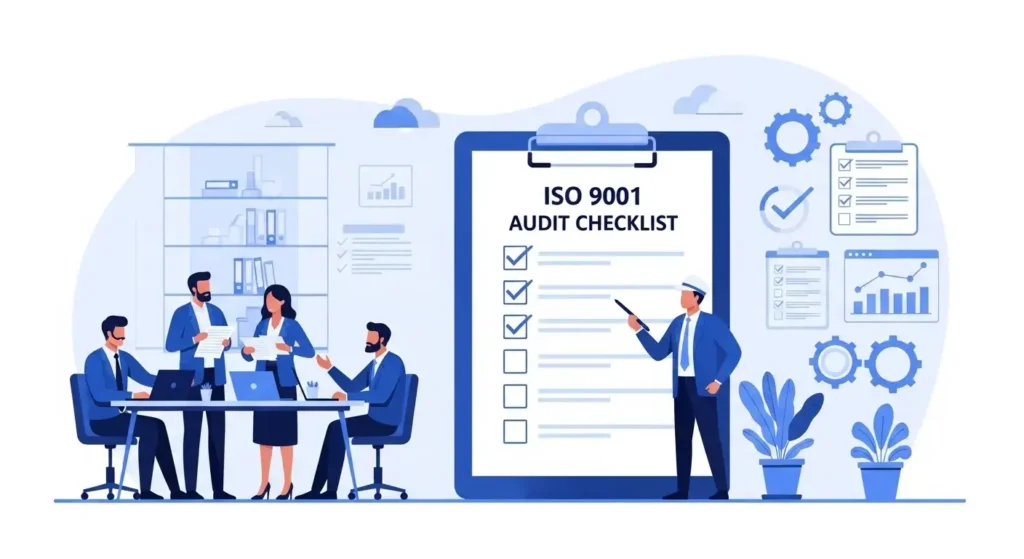
Preparing for an ISO audit can feel overwhelming. Many businesses fear failing the audit. There is also the worry of losing time or missing out on valuable contracts. But passing your audit does not have to be stressful. With the right preparation and a clear roadmap, you can achieve compliance quickly. You can also feel confident during the process.
This guide gives you a complete ISO 9001 audit checklist for 2026. We explain what auditors are looking for and how to avoid common mistakes. You will also learn how to speed up your path to certification. If you are a small business owner or a quality manager, you will find clear and practical advice to help you succeed.
What is an ISO 9001 Audit Checklist?
An ISO 9001 audit checklist is a structured tool. It helps you check if your company’s Quality Management System (QMS) meets the ISO 9001 standard. This checklist serves as a step-by-step guide for both internal and external auditors. It takes the complex ISO requirements and turns them into simple, clear questions you can answer easily.
By using this checklist, you can review your processes, documents, and records step by step. It helps you find gaps in your quality management system before they become problems during an external audit. Instead of struggling with a long regulatory document, you get a practical, easy-to-follow action plan. For an explanation of the basic rules, see what are ISO 9001 requirements.
Why You Need an ISO 9001 Audit Checklist
Going into an audit without a checklist is risky. It is like navigating a new city without a map. You could miss critical requirements. This can lead to major non-conformances.
Prevent Audit Failure
Failing an audit can cause serious problems. Your certification will be delayed. Costs can go up. Your reputation may suffer, especially with clients who require ISO compliance. Using a checklist gives you clear direction. It shows you exactly what to do and takes away the guesswork. This can turn anxiety into clarity.
Ensure Ongoing Compliance
A good checklist does more than help you pass a test. It helps your business keep high quality standards all year. You can use it to check if your team follows the right procedures. This ongoing review is very important. It matters even more in places with strict ISO audit requirements, like the UAE or under Saudi compliance standards. By auditing your processes often, you build a quality-focused culture. This leads to better customer satisfaction.
Learn more about the core standard with our guide to ISO 9001 certification.
ISO 9001 Audit Checklist – Quick Answer
What belongs on an ISO 9001 audit checklist? A complete ISO 9001 audit checklist checks your Quality Management System in relation to the main standard clauses. Include these essential points:
- Context of the organization and strategic goals
- Leadership commitment and quality policy
- Risk planning and quality objectives
- Resource support and documented information
- Operational planning and control
- Performance evaluation and internal audits
- Continuous improvement actions
Need help preparing for your ISO audit? Talk to our experts.
Full ISO 9001 Audit Checklist (Detailed)
We have divided the checklist into the main ISO 9001 clauses. This breakdown gives you full control as you prepare for your audit. Use each section below to check if you are ready.
Leadership (Clause 5)
Leadership commitment is essential for ISO 9001. Auditors want proof that top management is involved in the QMS.
- Is the quality policy documented, communicated, and understood by all employees?
- Has top management defined and assigned clear roles, responsibilities, and authorities?
- Can management demonstrate how they integrate QMS requirements into the company’s core business processes?
- Does management promote a customer focus throughout the organization?
Planning (Clause 6)
Planning means spotting risks early. It also means setting clear, measurable goals. You must show that you manage possible problems before they happen.
- Have you identified internal and external risks that could impact your QMS?
- Do you have documented action plans to address these risks and opportunities?
- Are your quality objectives measurable, monitored, and aligned with your quality policy?
- Is there a structured process for planning changes to the QMS?
Support (Clause 7)
Your QMS needs the right resources to work well. You need people, good infrastructure, and the right information.
- Do you provide the necessary resources (personnel, equipment, environment) to maintain the QMS?
- Are employees competent, and do you keep records of their training and experience?
- Are measuring and monitoring resources regularly calibrated and maintained?
- Do you control documented information properly, including secure storage and version control? Check our ISO 9001 documentation requirements guide for more details.
Operation (Clause 8)
This section explains how you design, produce, and deliver your products or services.
- Do you have a process to review customer requirements before committing to supply a product or service?
- Are design and development processes properly planned, controlled, and documented?
- Do you evaluate and monitor external providers (suppliers and contractors)?
- Are production and service provision strictly controlled to prevent errors?
- Do you have a clear procedure for handling non-conforming outputs?
Performance Evaluation (Clause 9)
You need to show that you track and review how well your system works.
- How do you monitor, measure, analyze, and evaluate customer satisfaction?
- Do you conduct internal audits at planned intervals?
- Does top management review the QMS regularly to ensure its continued suitability and effectiveness?
- Are the results of management reviews documented?
Improvement (Clause 10)
ISO 9001 expects you to keep improving your processes all the time.
- Do you have a system to capture, investigate, and correct non-conformities?
- Do you implement corrective actions to prevent problems from happening again?
- Can you show evidence of continuous improvement within your QMS?
Get a customized ISO 9001 audit checklist for your business. Contact us today.
ISO 9001 Internal Audit Checklist
Before the external auditor arrives, you need to conduct an internal audit. The internal audit checklist is almost the same as the external one. Think of it as a practice run for your team.
To run a successful internal audit:
- Schedule audits regularly: Do not wait until the week before your external audit.
- Train your auditors: Ensure internal auditors understand the standard and remain objective.
- Document findings: Record every non-conformance and area for improvement.
- Follow up: Make sure corrective actions are completed on time.
An effective internal audit will show you the weak spots, so you can fix them early. It builds confidence across your team. For more details on how this fits into your overall audit plan, review the ISO 9001 certification process step-by-step.
How to Prepare for ISO 9001 Audit
Getting ready for an ISO 9001 audit is easier when you plan ahead. Good preparation leads to a faster, less stressful audit. Use these practical steps to make sure you are ready:
- Perform a Gap Analysis: Compare your current processes against the ISO 9001 standard. Identify exactly what is missing.
- Update Documentation: Ensure all required policies, procedures, and records are current and accessible.
- Train Your Team: Make sure every employee knows the quality policy and understands their role in the QMS.
- Clean up the Workspace: A clean, organized environment signals to the auditor that you have things under control.
- Conduct a Mock Audit: Use your internal audit checklist to simulate the real event.
If you prepare well, you show the auditor that you understand and value the process. This builds trust. It also helps the audit go more smoothly.
Common ISO Audit Mistakes to Avoid
Many companies fail audits because of simple mistakes. Most of these errors are easy to avoid. Watch out for these common traps:
- Ignoring document control: Using outdated forms or failing to track document versions is a classic mistake.
- Lack of leadership involvement: If top management cannot explain the quality policy, the auditor will issue a major non-conformance.
- Failing to close corrective actions: Finding a problem during an internal audit is good. Failing to fix it before the external audit is a disaster.
- Overcomplicating the system: Keep your procedures simple. Do not write complex manuals if a simple flowchart works better.
- Poor employee awareness: If employees on the floor do not know where to find their work instructions, you will lose points.
Avoid these mistakes. You will move toward certification quickly and clearly. Want to know how this standard compares to environmental management? Read about ISO 9001 vs ISO 14001 key differences and benefits.
ISO 9001 Audit Checklist for Small Businesses
Small businesses often face unique challenges when they prepare for an audit. You may have fewer resources than larger companies. Your team members might take on several roles at once. Even so, the ISO 9001 standard can work well for smaller companies. It scales and adapts to your needs.
Your checklist should focus on practical application, not heavy bureaucracy. Make sure to communicate clearly. Use simple documentation. Keep a strong focus on your customers.
You do not need a large software system to pass an audit. Simple spreadsheets and well-organized folders work just as well. To see how certification helps your business grow, check the benefits of ISO 9001 for small businesses.
Download ISO 9001 Audit Checklist
Ready to take the next step? Don’t start from scratch. We have created a checklist you can use right away. It is comprehensive and actionable. Certified lead auditors designed it for real business needs.
Our premium checklist makes it easy to spot gaps. Use it to organize your documents and train your team. This is the same tool our auditors use to help clients pass on the first try. Instead of worrying about the audit, you can start preparing with confidence.
Get your ISO 9001 Audit Checklist (Free Guide 2026) – Global ISO Checklist now.
Why Choose Global ISO Certificates
Navigating ISO compliance requires expertise. Global ISO Certificates has years of experience helping businesses across the GCC region. We know the ISO audit requirements in the UAE. We also understand the strict Saudi compliance standards.
When you choose us, you get more than just advice. You gain a dedicated partner focused on your success. We simplify complicated ISO jargon to make it easy for you to understand. We also streamline your processes. This saves you both time and money. Our consultants work closely with your team. Together, we build a QMS that improves your business. We go beyond just ticking boxes for an auditor.
Wondering about the investment? Review our complete guide to ISO 9001 certification cost in UAE.
Get ISO 9001 Audit Support
Audit failure is a risk you do not have to take. Our expert guidance helps you achieve ISO 9001 certification quickly. You can do this without the usual headaches. We offer fast-track certification support. We also provide gap analysis and detailed internal audit services.
Do not let audit anxiety slow your business down. We can help you gain clarity and control. With our tools and support, you have what you need to succeed.
Contact Global ISO Certificates today for fast-track ISO 9001 audit support.
Talk to Global ISO Certificates experts today. Get your free checklist + expert consultation now.
Frequently Asked Questions (FAQs)
What is the main purpose of an ISO 9001 audit
How often should an internal ISO 9001 audit be conducted?
Most organizations conduct internal audits once a year. If you have high-risk processes or areas with frequent issues, you should audit them more often. This helps ensure you stay compliant at all times.
What happens if you fail an ISO 9001 audit?
Do small businesses need a different ISO 9001 checklist?
How long does an ISO 9001 audit take?
Can Global ISO Certificates help with audits in Saudi Arabia and the UAE?
Yes, our consultants have extensive GCC experience. We are fully versed in ISO audit requirements in UAE and all Saudi compliance standards.