
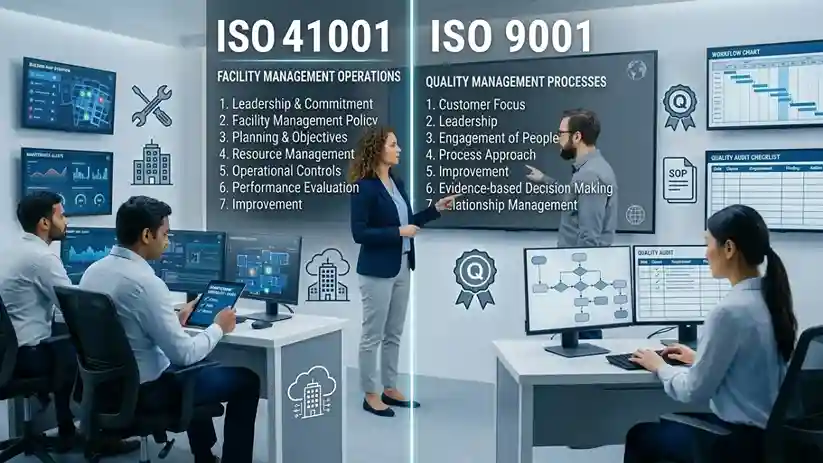
If you manage buildings, assets, vendors, and service levels, the wrong ISO standard can waste time and budget. ISO 41001 vs ISO 9001 is not just a paperwork question. It is a scope question.
ISO 41001 fits facility operations. ISO 9001 fits broader quality control across products, services, and business processes. If your main goal is better FM governance, service delivery, and asset support, ISO 41001 usually fits better.
For a complete overview of the standard and how to get certified, see our guide to ISO 41001 facility management certification.
What Is the Difference Between ISO 41001 and ISO 9001?
ISO 41001 vs ISO 9001 means comparing a facility management system standard with a quality management system standard. ISO 41001 focuses on buildings, support services, workplace performance, and FM outcomes. ISO 9001 focuses on quality controls, customer requirements, and process consistency across any industry.
| Criteria | ISO 41001 | ISO 9001 | Key Difference |
|---|---|---|---|
| Main purpose | Manages facility services and workplace support | Manages quality across products and services | ISO 41001 is FM-specific |
| Core focus | Service delivery, space, maintenance, support functions | Process quality, customer satisfaction, defect reduction | ISO 9001 is broader |
| Best fit | FM providers, in-house FM teams, property operators | Manufacturers, service firms, multi-function businesses | Scope of certification differs |
| Main outcome | Better facility operations and stakeholder experience | Better process control and continual improvement | One targets FMS, one targets QMS |
ISO 41001 helps you control the FM environment. ISO 9001 helps you control quality across the wider business. In a UAE tender context, that difference can shape prequalification and audit scope.
Takeaway: ISO 41001 is FM-specific, while ISO 9001 is business-wide.
What Does ISO 41001 Cover That ISO 9001 Does Not?
ISO 41001 covers the full facility management system around built assets, workplace support, outsourced services, and user needs. ISO 9001 does not go that deep into FM operations.
What Is the Scope of ISO 41001 Facility Management?
ISO 41001 certification applies to organizations that plan, manage, and improve facility services. This includes maintenance, cleaning, security, space planning, utilities, contractor control, and user experience.
It also looks at how FM supports business goals. That means governance, risk, performance measures, emergency readiness, and stakeholder satisfaction all matter. The standard links service delivery to business value.
ISO 41001:2018 gives FM teams a structured way to manage assets, people, places, and processes. It is the only international standard built for FM. According to ISO.org, it was created to improve the health, safety, and productivity of the workforce and the core business. This international organization developed ISO 41001 to help organizations address risks, environmental impact, and occupational health while enhancing operational efficiency.
Takeaway: ISO 41001 covers the real work of FM, not just generic quality controls.
What Does ISO 9001 Focus On Instead?
ISO 9001 certification focuses on consistent outputs, customer needs, process control, and continual improvement. It works across sectors because it does not depend on a single function.
A quality management system can cover sales, procurement, design, service delivery, support, and complaints. It asks whether your process delivers expected results in a repeatable way.
That is useful for FM companies with a broad service portfolio. But it does not replace a facility management system when your main challenge is managing buildings, hard services, and support contracts.
ISO 9001 is the most recognized quality management system worldwide, providing a structured framework for quality assurance and quality control. It supports strategic planning and continuous improvement to meet customer expectations and increase profits.
Takeaway: ISO 9001 improves process quality, but it does not define FM control in detail.
Why Would a Facility Manager Choose ISO 41001 Over ISO 9001?
A facility manager should choose ISO 41001 when FM is the main business function or the main operational risk area. It gives you a clearer fit for contracts, service levels, asset support, and workplace outcomes.
Which Situations Call for ISO 41001 Certification?
ISO 41001 certification makes sense when you run complex sites, multiple vendors, or high service expectations. It also helps when procurement teams ask for proof of structured FM governance.
You may need it if you manage:
- Corporate offices
- Hospitals
- Schools and campuses
- Airports and transport hubs
- Residential and mixed-use portfolios
- Industrial or logistics sites
It also helps when you want better operational efficiency across maintenance, cleaning, front-of-house, utilities, and workplace services. In many Saudi Arabia projects, clients now expect stronger FM controls before awarding long-term service contracts.
ISO 41001 certification offers cost benefits by reducing operational costs and improving service management. It also supports cyber security and privacy protection aspects relevant to modern facility management teams.
Takeaway: Choose ISO 41001 when FM performance drives risk, cost, and user satisfaction.
When Does ISO 9001 Make More Sense for FM Teams?
ISO 9001 makes more sense when FM is one part of a wider business model. For example, a large service company may need one quality management system across many departments.
You may prefer ISO 9001 if you want:
- One standard for all business units
- Better quality control across service lines
- A first certification before adding FM-specific standards
- Stronger complaint handling and process consistency
This means ISO 9001 works well when your board wants one management framework across the enterprise. In contrast, it may not give facility leaders enough FM-specific control on its own.
Choose ISO 9001 when you need broad quality governance more than FM-specific structure.
| Choose ISO 41001 if… | Choose ISO 9001 if… |
|---|---|
| Your main scope is facility operations | Your scope covers many business functions |
| You manage buildings, support services, and assets | You need one quality framework for all departments |
| Clients ask for FM-specific proof | Clients ask for general quality assurance |
| You want an FMS built for workplace and built environment outcomes | You want a QMS built for process consistency |
How Do ISO 41001 and ISO 9001 Work Together?
ISO 41001 and ISO 9001 can work together well. Many organizations use both when they need FM control and wider quality control.
What Is the High-Level Structure and Why Does It Matter?
Both standards follow the high level structure, often called HLS. This means they share the same clause logic for context, leadership, planning, support, operation, performance evaluation, and improvement.
That shared format makes integration easier. Your team can align document control, internal audits, corrective action, and management review across both systems.
You do not need to build two isolated systems. You can build one integrated management system with shared controls and separate operational requirements.
Takeaway: HLS makes ISO 41001 and ISO 9001 easier to combine.
How Do You Build an Integrated Management System?
Start with your common processes. These often include risk review, competence, supplier control, audit planning, and nonconformity handling.
Then map where each standard has unique needs. ISO 41001 goes deeper into workplace, support services, and FM governance. ISO 9001 goes deeper into customer requirements, process quality, and output consistency.
Organizations that already hold ISO 55001 asset management certification can integrate ISO 41001 without rebuilding their management system from scratch.
A simple path looks like this:
- Run a gap analysis
- Define scope of certification
- Map shared clauses
- Add FM-specific controls
- Train process owners and employees
- Run internal audit
- Close corrective action
- Select a certification body
This approach reduces duplicate work. It also helps procurement and compliance teams see one clear control structure.
Takeaway: Build one system with shared clauses, then add FM-specific requirements where needed.
Which Organizations in the Middle East Use ISO 41001?
ISO 41001 suits organizations that manage large facilities, outsourced contracts, or high public expectations. That includes property developers, hospitals, universities, airports, FM service providers, and government-linked entities.
FM providers pursuing ISO certification in UAE often find that ISO 41001 is listed as a preferred standard in government and private sector tenders.
It also fits owners and operators who want a clear facility management system for tenant experience, uptime, and asset management. In the Gulf FM market, that can support stronger bidding and contract renewal outcomes.
ISO 9001 still appears often in mixed-service firms. But where FM is the core service, ISO 41001 usually gives a better market signal.
Takeaway: Middle East organizations use ISO 41001 when FM performance affects tenders, trust, and service outcomes.
How Do You Get Started With ISO 41001 Certification?
Start by checking whether your current FM controls already match the standard. Many teams already have parts of the system in place, but they lack structure.
Before you decide, review the clause-by-clause ISO 41001 requirements checklist to see how much of your current FM system already qualifies.
Then follow a simple sequence:
- Set the scope of certification
- Review your FM processes
- Run a gap analysis
- Write or update needed controls
- Train teams and suppliers
- Monitor KPIs
- Complete an internal audit
- Fix issues through corrective action
- Book the external audit
Here is a simple summary checklist.
| Step | What You Check | Why It Matters | Owner |
|---|---|---|---|
| Scope | Sites, services, entities, exclusions | Sets audit boundaries | Leadership |
| Process map | Maintenance, cleaning, security, helpdesk, vendors | Shows your FMS design | FM team |
| Risks and objectives | Service failures, uptime, user needs, compliance | Links FM to business goals | FM and compliance |
| Evidence | SOPs, logs, KPIs, contracts, reviews | Supports audit readiness | Process owners |
| Audit and actions | Internal audit, findings, corrective action | Confirms system works | Audit team |
You should also choose a certification body with FM audit experience. That helps you get practical audit feedback, not just generic quality comments.
If your organization already has ISO 9001 certification, the project may move faster. Shared clauses reduce document work and speed up adoption.
Takeaway: Start with a gap analysis, then build evidence around your FM scope and performance controls.
Frequently Asked Questions —ISO 41001 vs ISO 9001
What is the main difference between ISO 41001 and ISO 9001?
ISO 41001 is a facility management system standard. ISO 9001 is a quality management system standard. ISO 41001 focuses on FM operations, while ISO 9001 focuses on process quality across the business.
Which ISO standard is best for facility management?
ISO 41001 is usually the better fit for facility management. It was built for FM service delivery, workplace support, asset-related processes, and stakeholder needs.
Can an FM company have both ISO 41001 and ISO 9001?
Yes. Many FM companies use both. ISO 41001 manages FM-specific controls, while ISO 9001 supports wider quality controls and continual improvement.
Is ISO 41001 certification better than ISO 9001 certification?
Neither is better in every case. ISO 41001 certification is better for FM-specific needs. ISO 9001 certification is better for broad business quality management.
How long does ISO 41001 certification take?
The timeline depends on your current system, number of sites, and readiness level. Many organizations need a few months to complete a gap analysis, implement controls, run internal audit, and prepare for certification.
If your business runs on buildings, service partners, and workplace performance, the ISO 41001 vs ISO 9001 choice should start with scope. Pick ISO 41001 when FM is the core need. As Middle East FM certification demand grows, a clear standard choice can help you spend budget where it adds the most value.