









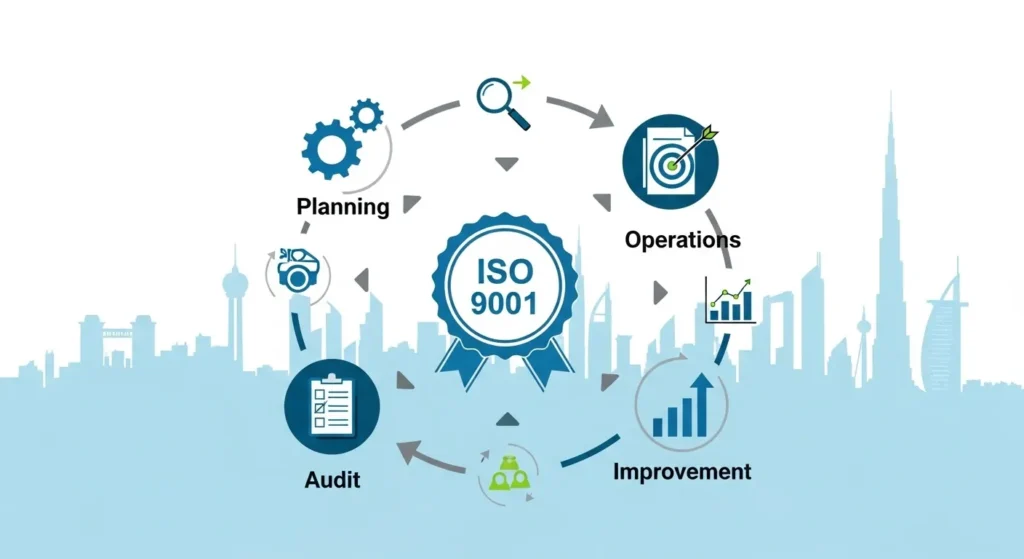
Many businesses find ISO 9001 requirements confusing. Reading the official standard can be tough and full of technical words. Terms like “clauses” and “compliance” add to the confusion.
You might worry that the process is too complicated. You do not need to stress anymore.
This guide explains everything in plain language. We break down the ISO 9001 requirements list for you.
You will soon know what your business needs to do.
What Are ISO 9001 Requirements?
ISO 9001 requirements are rules set by the ISO standard. These rules help you build a strong quality management system. A good system helps you deliver quality products and services.
Meeting these rules helps your business get ISO 9001 certification. You need to follow the rules to succeed in your audit.
Why ISO 9001 Requirements Matter for UAE & Saudi Businesses
Knowing ISO 9001 quality management requirements gives your business real value.
- You meet the law and local rules.
- Your company can apply for bigger contracts and government tenders.
- Customers trust you because you meet international standards.
Big projects often need ISO certification if you want to bid. This can help you stay ahead of other companies.
If you want to learn more about pricing, check the ISO 9001 certification cost in UAE.
This is where most companies need expert guidance.
Complete List of ISO 9001 Requirements
Let’s get ISO 9001 clauses explained in a simple way. The ISO 9001 standard has ten main sections, or clauses:
- Clauses 1 to 3 explain the scope and terms.
- Clauses 4 to 10 list the requirements your business must follow.
Here are the key requirements:
Clause 4 – Context of the Organization
Know your business environment. Understand what affects your goals. Find out who has an interest in your work.
Example: Make a list of your suppliers, customers, and local regulators.
Clause 5 – Leadership
Leaders should be in charge of quality. Create and share a quality policy. Give employees clear roles and duties.
Example: The CEO signs and shares the quality policy with all staff.
Clause 6 – Planning
Plan for problems before they happen. List risks and ways to manage them. Set clear quality goals for your team.
Example: Set a target to lower customer complaints next quarter.
Clause 7 – Support
Help your team succeed. Give them the tools, resources, and training they need. Make sure everyone knows the quality policy.
Example: You organize new quality training for your team.
Clause 8 – Operation
Control how you make and deliver your product. Double-check customer needs before you begin. Make sure you meet those needs every time.
Example: Inspect raw materials before making the product.
Clause 9 – Performance Evaluation
Check how your business is doing. Run regular internal audits. Review your system and make changes if needed.
Example: Send out a customer survey each quarter and review the feedback.
Clause 10 – Improvement
Keep making your system better. Fix problems fast and find out why they happened. Change your process so the problems do not return.
Example: Update your process if a mistake is found during an audit.
ISO 9001 Documentation Requirements
You do not need a lot of paperwork. You only need clear documents that show you follow the rules.
Here are the key documents you should have:
- Quality policy
- Quality goals
- Written procedures
- Records of results
- Internal audit reports
- Management review meeting notes
Proper implementation reduces audit failure risk.
Different industries keep some extra documents.
- Construction companies keep safety records.
- Logistics companies track delivery and shipping proof.
- Oil and gas businesses keep equipment maintenance logs.
ISO 9001 Requirements for Different Industries
The basic rules are the same for all businesses. But you will use them differently in daily work.
Construction
Builders use ISO 9001 to keep projects safe and on time. Learn more about ISO certification for construction companies.
Logistics
Transport companies use ISO to make sure deliveries are on schedule. See what’s covered in ISO standards for logistics.
Oil & Gas
Energy companies use it to reduce risk and avoid mistakes. Learn about ISO certification for oil & gas industry.
Medical
Healthcare clinics use ISO 9001 to improve patient care and safety.
Automotive
Car makers use ISO to reduce defects and speed up production.
Working with experts speeds up certification.
ISO 9001 Requirements in UAE, Saudi Arabia & Qatar
High standards are important in these regions.
In the UAE, many firms need ISO 9001 to win contracts. Government projects want vendors with ISO. See more about ISO certification in UAE.
In Saudi Arabia, the Vision 2030 plan pushes companies to raise their standards. Check details about ISO certification in Saudi Arabia.
In Qatar, infrastructure projects require strict quality rules. Learn more at ISO certification in Qatar.
Common Mistakes While Implementing ISO 9001 Requirements
Many companies fail audits because of simple mistakes. Avoid these common traps:
Too Much Documentation
Do not document more than you need. Keep it simple and clear so your team can follow it.
Not Enough Training
Your team must know the rules and how to follow them. Untrained staff will not follow new steps.
Skipping Audits
Never miss your internal audit dates. Audits pick up problems before they get worse.
How to Meet ISO 9001 Requirements Easily
You can make ISO certification simple if you follow these steps:
- Work with a qualified ISO consultant. They know what auditors want.
- Keep your documents simple. Only write what adds value.
- Train your staff early. Good training makes implementation easier.
Conclusion
Understanding ISO 9001 does not need to be hard. Focus on improving your business, not just paperwork. Keep things simple and train your staff. Do not let complex language stop your progress.
Get expert support to implement ISO 9001 without delays or confusion.
Frequently Asked Questions
What are ISO 9001 requirements?
They are a set of rules to make a quality management system. They help businesses deliver better products and services.
How many clauses are there?
There are ten main clauses in ISO 9001. Clauses 4 to 10 list the practical requirements.
Is ISO 9001 hard to achieve?
No. With good planning, ISO 9001 is simple. An expert can help you go faster.
What documents do I need?
You need a quality policy, quality objectives, written procedures, and audit records.
Who needs to follow ISO 9001 requirements?
Any business that wants to improve quality and customer satisfaction can follow ISO 9001 requirements. It applies to all industries and company sizes.
Are ISO 9001 requirements the same for every industry?
Yes, the core requirements are the same. However, how they are applied can vary based on the industry and business operations.
Can ISO 9001 requirements be implemented without a consultant?
Yes, it is possible. However, many businesses choose consultants to save time and avoid mistakes during implementation.