






ISO 9001 vs ISO 14001: Key Differences, Benefits & Which One to Choose (2026)
Are you wondering which ISO certification your business really needs? Many companies find the list of ISO standards overwhelming. Picking the wrong certification wastes time, money, and resources that could be better spent growing your business.
But the good news? You can avoid these mistakes and chart a clear, smart course. This simple guide shows you the big differences between ISO 9001 and ISO 14001 in plain language. By the end, you’ll know which standard fits your organization, the key benefits you gain, and how to make a confident decision that suits your future goals.
What Is ISO 9001?
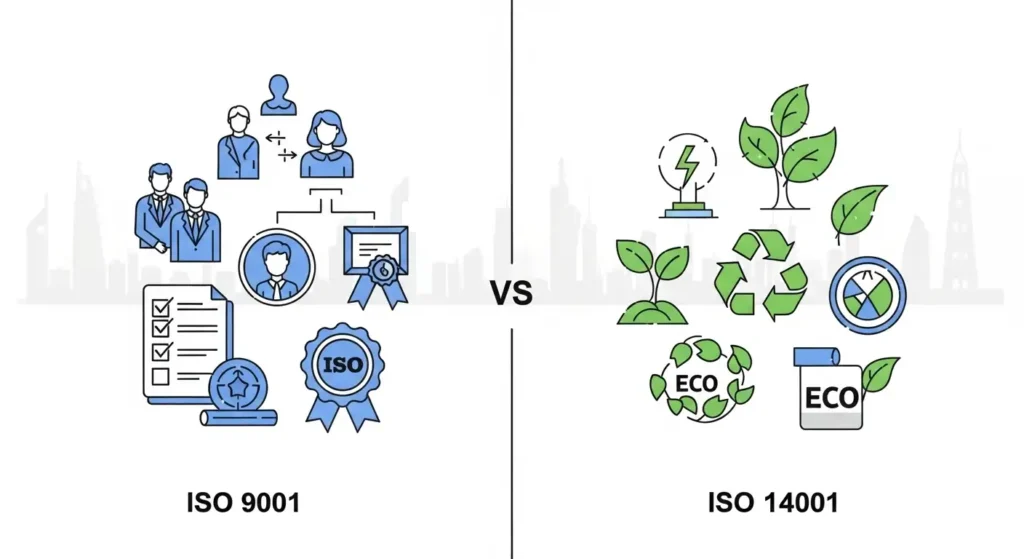
ISO 9001 is the world’s most trusted standard for quality management systems—often called a QMS. This standard gives businesses, big and small, a step-by-step method to produce goods and services customers can trust. No matter your industry, ISO 9001 focuses on helping you deliver consistent results every time.
How Does ISO 9001 Work?
ISO 9001 asks you to set up simple, easy-to-follow processes with clear roles for every staff member. Everything centers around meeting the needs of your customers, from the very first contact all the way through delivery and after-sale support.
- It sets out clear, repeatable steps for every area of your business.
- It demands leadership involvement and goal-setting.
- It encourages your team to report problems and join in finding solutions.
- It helps create a company culture where improvement is normal, not a hassle.
- It ties each process to ways you can review—then improve—results.
When you achieve ISO 9001 certification, you show customers and partners that quality is your top priority. Many public tenders and big contracts require it. For more details, visit our ISO 9001 certification resource for a full step-by-step guide.
Why Do Businesses Choose ISO 9001?
When you choose ISO 9001, you gain:
- Strong, lasting customer trust and repeat business
- Stability and efficiency in day-to-day work
- Better teamwork and communication across teams
- Fewer mistakes, less waste, and lower costs
- Easier access to new contracts and markets
- Faster problem-solving and improved staff morale
If your goal is to impress clients, win contracts, and cut back on returns or complaints, ISO 9001 delivers real value.
What Is ISO 14001?
ISO 14001 is the global standard for environmental management systems, or EMS for short. It’s a practical framework designed to help your business reduce waste, use resources wisely, and limit your impact on the planet. As demand for eco-friendly business rises, ISO 14001 has become more important than ever.
How Does ISO 14001 Work?
ISO 14001 gives you a system to identify and manage risks that could harm the environment. You look closely at waste, pollution, and how much energy you consume. The focus is always on cutting your footprint while also meeting environmental laws.
- You set simple policies to guide your team in green practices.
- You track energy, water, and material use, then look for ways to do better.
- You fix problems before they turn into accidents or fines.
- You work with regulators and communities to meet bigger goals.
- You build a work culture where everyone thinks about sustainability.
Achieving ISO 14001 certification tells the world your business cares for the planet. Today, this gives you a big edge with both buyers and communities.
Why Do Companies Choose ISO 14001?
Going green with ISO 14001 brings you:
- Lower operating costs by cutting energy and waste
- Stronger compliance with local and international rules
- A better reputation and more trust in your brand
- Fewer risks of costly accidents or legal issues
- A team that’s proud to work for a responsible employer
- New opportunities with clients focused on sustainability
As laws adapt and buyers look for greener partners, ISO 14001 will only rise in value.
ISO 9001 vs ISO 14001 – Key Differences
Understanding the difference between these two ISO standards is the first step to making the right choice for your business. Here is a side-by-side comparison to help you decide:
| Feature | ISO 9001 (Quality Management) | ISO 14001 (Environmental Management) |
|---|---|---|
| Focus | Quality of services and products | Environmental impact |
| Goal | Meet customer expectations | Cut pollution and waste |
| Main Users | All company types and sizes | Businesses impacted by regulations/eco-demands |
| Who Benefits Most | Customers and clients | Society, regulators, and stakeholders |
| Success Metric | Fewer complaints, high satisfaction | Less waste, lower resource use |
| Demand in Marketplace | High for most industries | Quickly rising as green rules spread |
| Internal Benefits | Better processes, clear roles | Leaner operations, reduced cost |
| Legal Requirement | Sometimes | Common in high-impact industries |
| Impact on Reputation | Proves reliability and trust | Shows serious green commitment |
ISO 9001 helps you boost quality and trust. ISO 14001 shows you care about the planet and meet strict rules. Many businesses get both, but you should start with whichever suits your most urgent business need.
Which ISO Standard Is Right for Your Business?
Both ISO 9001 and ISO 14001 unlock benefits, but it’s crucial to pick the one that will have the biggest impact right now.
Choose ISO 9001 if your goal is to:
- Raise quality and deliver reliable results every time
- Strengthen customer satisfaction and win trust
- Access large contracts that require ISO 9001
- Fix problems before they hurt your brand
- Boost efficiency and teamwork across all departments
- Open new business opportunities at home or abroad
ISO 9001 is often the first choice for manufacturing, construction, healthcare, logistics, and professional services. Many public contracts require it. Find out more in our ISO 9001 certification guide.
Choose ISO 14001 if your goal is to:
- Reduce waste, pollution, and your carbon footprint
- Stay ahead of changing environmental laws and rules
- Win bids needing green credentials or a “sustainable” supply chain
- Build a brand known for environmental responsibility
- Avoid big fines, negative press, or poor relations with the community
- Attract staff and partners who value sustainability
Industries like construction, oil and gas, energy, food, agriculture, and logistics see the most benefits from ISO 14001.
Can You Combine ISO 9001 and ISO 14001?
Yes! Many organizations now integrate their quality and environmental management systems. You create one system, known as an Integrated Management System (IMS).
What Are the Benefits of Combining?
- Only one audit—save time and money
- Fewer documents and simpler procedures
- Teams work with one shared process
- Quicker staff training, easier to keep standards fresh
- Higher appeal to global clients, especially large or regulated ones
- Smoother coordination, risk management, and planning
Combining saves up to 30% over running two systems separately. It also boosts staff engagement and cross-team communication.
Benefits of ISO 9001 vs ISO 14001
ISO 9001 Benefits
- You reduce common errors and rework.
- Staff know exactly what’s expected—and have tools to perform.
- Results are more predictable and reliable.
- Clients gain confidence, boosting repeat business.
- New products or markets are easier to pursue.
- You create a culture of ongoing improvement.
- You strengthen your position in competitive bids.
- Better data enables smart, evidence-based decisions.
ISO 14001 Benefits
- Your energy and resource costs drop.
- Risk of accidents or spills is lower.
- Insurers reward you for good management.
- Green investors and regulators trust your approach.
- Community and customer loyalty improves.
- Legal disputes become rare or easier to handle.
- Helps meet global supply chain requirements.
- Your workforce feels good about working for a green company.
ISO 9001 vs ISO 14001 – Quick Comparison Table
| Area | ISO 9001 | ISO 14001 |
|---|---|---|
| Improves | Service/Product quality | Environmental footprint |
| Helps with | Bidding/contract win rate | Compliance with green regulations |
| Reduces | Mistakes, waste, customer churn | Fines, resource costs, pollution |
| Builds | Customer trust, efficiency | Green reputation, community trust |
| Prepares for | Scaling/new markets | Law changes, supply chain audits |
ISO 9001 vs ISO 14001 in UAE, Saudi Arabia & Qatar
If your business is in the Middle East, you face unique challenges. Local laws make quality and sustainability crucial for any serious company.
UAE
The United Arab Emirates leads the region for quality and green requirements. Public and private contracts expect you to prove your management processes. ISO certification is often mandatory. Focus on ISO certification in UAE for more advice and regulations.
Saudi Arabia
Saudi Arabia’s Vision 2030 prioritizes both strong business and environmental leadership. Sectors like construction, oil, and logistics must meet strict ISO rules. See how to meet all requirements in our guide for ISO certification in Saudi Arabia.
Qatar
Qatar invests in sustainable development, making green certifications a basic necessity for government and industry contracts. Review our ISO certification in Qatar resource for local requirements.
Industry Use Cases
Construction Industry
Firms use a quality management system to stop rework, cut costs, and meet tight deadlines. ISO 14001 ensures they manage waste safely, minimize noise/dust, and comply with tough environment laws—helping to win contracts, especially for public infrastructure.
Oil & Gas Sector
The oil and gas field faces intense global rules. ISO standards for oil and gas prevent leaks, manage risk, and protect workers and the environment. Many companies use both standards to gain community trust and stay ahead of fines and shutdowns.
Logistics Operations
Logistics providers use ISO 9001 for reliable delivery and customer satisfaction. Adding ISO 14001 shows clients they cut emissions and use resources wisely—a huge selling point for major supply chains.
Explore sector-specific guides:
Cost Comparison of ISO 9001 vs ISO 14001
Knowing the cost helps you plan. Here are the main things to think about:
- ISO 9001: Lower cost for small and medium companies. Covers consulting, audits, and staff training.
- ISO 14001: Higher if you need specialized audits, new tools, or upgrades for compliance.
- Combined Certification: Saves money if you do both at once via an Integrated Management System.
What Impacts Your Cost?
- Your company’s size and the number of sites
- Type and number of processes to certify
- Current systems in use
- How much training your staff needs
- Amount of documentation and audit time
- Industry requirements for testing or equipment
See our full breakdown: ISO 9001 certification cost in UAE.
Budget for regular reviews—even after you get certified! It helps you keep improving, avoid fines, and win new business.
Common Mistakes When Choosing ISO Standards
Don’t fall for these pitfalls:
- Picking the standard your rival has—without checking your needs
- Forgetting to bring your team into the decision
- Rushing for a certificate instead of planning for better processes
- Ignoring long-term needs—choose a standard that grows with you
- Treating compliance as a one-time event
Take your time, ask expert advice, and involve staff from the start. You’ll avoid wasted spending and failed implementations.
Conclusion
Making the right ISO choice unlocks lasting business rewards. Both standards offer strong ways to boost your reputation, meet modern demands, and grow profitably—if you align your choice with your goals.
Choose the right ISO certification with expert guidance. Let the experts map out your journey so you avoid the usual hurdles, save money, and get certified quickly.
Frequently Asked Questions
Which is better ISO 9001 or 14001?
Neither is “better”—they serve different goals. ISO 9001 boosts your quality, helps win contracts, and cuts errors. ISO 14001 protects the environment, helps with compliance, and improves your green reputation.
Can small businesses use both?
Yes! Many small businesses combine both standards for the same audit. This saves money and keeps things simple.
Which is cheaper ISO 9001 or ISO 14001?
ISO 9001 is usually less costly for first-time certification. ISO 14001 costs slightly more due to the need for measuring environmental impact and possibly upgrading facilities.
Do I need ISO 9001 before ISO 14001?
No. You can get either one first, or both together. Many businesses start with the standard that matches urgent client or legal demands.
How long does certification take?
Most businesses take between three to nine months from planning to certificate. Large or complex firms may need up to a year. Good planning speeds things up.
Will ISO standards guarantee success?
Standards alone don’t guarantee profits. But they provide proven methods to improve your processes and help your team succeed. Real results come from using the standards daily.