
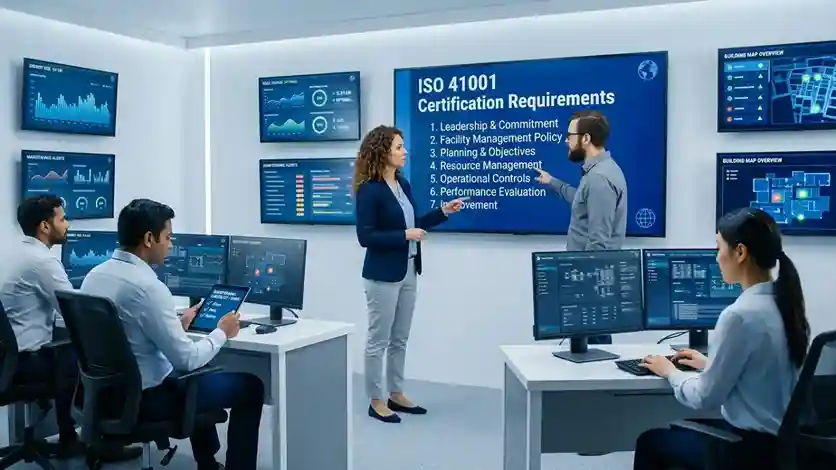
If you manage buildings, vendors, assets, or service levels, you need a clear system for control. FM teams often grow fast, but their processes do not keep up. This gap can cause missed SLAs, weak records, higher risk, and poor audit results.
This guide explains the ISO 41001 requirements in simple terms. It is for facility managers, compliance officers, and operations directors who want a clear checklist—not audit jargon. If you work in the UAE, Saudi Arabia, Qatar, or Africa, this helps you align your FM system with buyer and regulator needs.
You will find out what ISO 41001 requires, what each main clause means, how to get your team ready, and what happens during a facility operations audit. You also get a checklist for each clause to use right away.
What Are the ISO 41001 Requirements?
ISO 41001 requirements are the main rules your organization must follow for building and managing a facility management system. These rules cover your FM context, leadership roles, planning, support, daily operations, regular checks, and ongoing improvements. They help you deliver steady FM services, lower risks, and get ready for ISO 41001 certification.
ISO 41001 gives you a clear structure for facility management, known as an FMS. It brings together people, places, processes, and services in one system.
Before building your FMS, it helps to understand the full scope of ISO 41001 facility management certification — including who it applies to and what the certification journey looks like.
The standard asks you to plan your FM services, follow the law, control risk, check performance, and always improve. It does not tell you exactly how to run FM. It explains the results your system must achieve and record.
At a high level, you need to:
- Define the scope of your FM system
- Understand internal and external issues
- Identify interested parties and their needs
- Set FM policy and measurable objectives
- Plan for risks and opportunities
- Control outsourced services and operations
- Track performance with clear metrics
- Run internal audits and management reviews
- Fix issues and improve the system
Start by checking your current FM process against these points. Most teams spot gaps in records, KPIs, supplier checks, or review steps.
Why Does Your Organization Need ISO 41001 Certification?
ISO 41001 certification gives your FM team a clear system to follow. You get fewer surprises, better service results, and more trust from clients and partners.
If you make B2B decisions, ISO 41001 certification gives you practical value. It helps you:
- Standardize service delivery across sites
- Improve vendor and contractor oversight
- Reduce service failures and reactive work
- Support tenders and prequalification requests
- Show governance to boards and buyers
- Strengthen legal and compliance controls
- Build confidence during acquisitions or expansions
Many FM buyers in the Middle East want clear standards from their service partners. This is true for the UAE and Saudi Arabia, where big sites and outsourcing make strong FM controls very important.
Certification helps your team work in the same way across help desk, maintenance, cleaning, security, space use, and contractor tasks. Everyone follows the same process, making it easy to scale your operations.
If you do not set clear processes, the system relies on people. When someone leaves, the quality of your FM drops. ISO 41001 makes your setup stable and prevents this problem.
Comparison: Before and After ISO 41001 Alignment
| Area | Without a Structured FMS | With ISO 41001 Alignment |
|---|---|---|
| Service delivery | Inconsistent by site or manager | Standardized and measured |
| Supplier control | Basic contract oversight | Defined criteria, monitoring, review |
| Risk management | Reactive issue handling | Planned risk and opportunity actions |
| Compliance records | Scattered and incomplete | Controlled and accessible |
| KPIs | Limited or unclear | Set, tracked, reviewed |
| Audit readiness | Last-minute document chase | Ongoing evidence and routine checks |
| Client confidence | Depends on personal trust | Backed by system and certification |
What Does ISO 41001:2018 Cover? Clause-by-Clause Breakdown
ISO 41001:2018 uses the same structure as other ISO management system standards. This makes it simple to match with ISO 9001 or ISO 14001.
The main clauses you must follow start at Clause 4 and end at Clause 10. Here is a simple summary for decision-makers.
What Is Clause 4? Understanding Organizational Context
Clause 4 tells you to look at what affects your FM system, both inside and outside your organization. You must list the factors that shape your FM work, such as business goals, laws, contracts, and who uses your services.
That includes:
- Business goals
- Portfolio type and scale
- Regulatory demands
- Contract model
- Stakeholder needs
- FM boundaries and responsibilities
You must also list all interested parties. These are people or groups such as tenants, staff, visitors, landlords, clients, regulators, vendors, and insurers.
Next, you set the scope for your facility management system. This means you decide what is included and what is not. Make your scope clear and specific. If it is not, audits become difficult.
Clause 4 requires you to define context, stakeholders, scope, and core FM processes before you build the rest of the system.
What Is Clause 6? Planning for Risks and Opportunities
Clause 6 is about planning for risks and opportunities. You need to spot anything that could affect your FM targets or service quality.
This often covers:
- Service interruption risk
- Asset failure risk
- Safety and compliance gaps
- Supplier performance risk
- Customer complaint trends
- Resource or skill shortages
You also need clear, measurable objectives. These goals should be specific and easy to track. For example, you can measure response time, completed maintenance tasks, resolved complaints, energy use, or if contractors meet standards.
Clause 6 requires you to plan actions for FM risks and opportunities and set measurable goals for system performance.
What Is Clause 8? Operational Planning and Control
Clause 8 is about making sure your daily FM operations run the same way each time. It explains how to keep service consistent by setting clear steps and controls.
This can include:
- Work order control
- Planned maintenance
- Service specifications
- Outsourced provider oversight
- Change management
- Emergency readiness
- Asset and space support activities
If you outsource cleaning, security, MEP, or soft services, Clause 8 is even more important. You must set clear service rules, methods to check quality, and keep records to show you control these activities.
In Qatar and the UAE, many FM contracts use more than one vendor. Organizations seeking ISO certification in UAE increasingly list ISO 41001 as a requirement in FM tenders and government contracts. Clause 8 lets you set simple controls to manage these different suppliers with clear steps and checks.
Clause 8 requires planned operational controls, supplier oversight, and documented methods to deliver FM services as intended.
ISO 41001 Requirements by Clause: Checklist
| Clause | What It Covers | What You Should Have Ready |
|---|---|---|
| 4 | Context of the organization | Scope, stakeholder list, process map, issue analysis |
| 5 | Leadership | FM policy, roles, responsibilities, leadership commitment |
| 6 | Planning | Risk register, objectives, action plans, change planning |
| 7 | Support | Competence records, communication plan, documented information |
| 8 | Operation | Operational controls, service procedures, supplier controls, emergency plans |
| 9 | Performance evaluation | KPIs, monitoring records, internal audit plan, management review minutes |
| 10 | Improvement | Nonconformity logs, corrective action records, improvement actions |
This checklist is your basic FMS certification checklist. Use it to check your current documents, who is responsible, and what proof you have ahead of a gap review.
How Do You Meet ISO 41001 Requirements? Step-by-Step
You do not have to do everything at once. The best way is to take small steps. Keep each step clear and use proof for every action you take.
Step 1: Define Your FM Scope and Service Boundaries
Start with the sites, services, and functions included in your FMS. List what is in scope and what is out of scope.
Include:
- Locations
- Service lines
- Internal teams
- Outsourced providers
- Contract boundaries
This step clears up who manages what. It helps everyone know their roles and stops mix-ups down the line.
Step 2: Run a Gap Review Against the Standard
Check your current system against the ISO 41001:2018 clauses. If you already hold ISO 55001 asset management certification, your risk registers and asset performance records give you a strong head start on Clause 6 planning requirements.
Look for areas where you already have controls and places where you rely on old habits.
Common gaps include:
- No formal FM policy
- Weak objective tracking
- Limited supplier review
- Missing internal audits
- Poor document control
- No structured corrective action process
Remember, proof is just as important as process. If you do not keep records, auditors may say the work was not done.
Step 3: Build Core Documents and Controls
Keep your documents simple. Only create paperwork you need to run your FM system and show proof during audits. Examples include:
- FM policy
- Scope statement
- Risk and opportunity register
- KPI dashboard
- Supplier evaluation method
- Audit schedule
- Management review agenda
- Corrective action log
Step 4: Train Process Owners and Frontline Leads
A standard fails when only one person understands it. Site managers, engineers, help desk staff, and contract managers all need simple, clear training for their roles.
Teach each person their main tasks. Cover:
- Their daily duties
- The records they must keep
- How to handle problems and raise issues
- How to track and report KPIs
- What to do if things go wrong
Step 5: Measure, Audit, and Review
When your system is live, check how it works. Track results, do an audit, then meet with leaders to discuss what you found.
This cycle makes your FMS real and prepares you for external certification.
Step 6: Close Gaps Before Certification
Do a full internal check before your audit. Fix any weak spots before the certification body visits.
Check for:
- Missing records
- Unclear ownership
- Old procedures
- Incomplete reviews
- Unresolved corrective actions
To meet the standard, set up clear controls, train your team, and keep good records at every step.
Which Organizations Must Follow ISO 41001 Standards?
ISO 41001 is not a legal requirement for every business. Some organizations choose to adopt it because it offers clear benefits. Many buyers also prefer working with certified facility managers.
ISO 41001 works for any group that handles buildings or services. It does not matter if you run FM in-house or use outside providers. Examples include:
- Property developers
- Corporate real estate teams
- Hospitals
- Airports
- Universities
- Retail groups
- Industrial sites
- Government entities
- FM service providers
- Mixed-use asset operators
If you manage several sites, important assets, or have high service demands, ISO 41001 can help you. This standard also makes it easier to show your process is strong when buyers or teams ask for proof.
In Saudi Arabia and across big Gulf projects, FM service quality can shape tenant satisfaction, asset value, and contract renewals. With a clear ISO 41001 facility management system, you show buyers and partners that your team is in control.
Not every organization must use ISO 41001. Still, if your facility management affects business results, you should consider it. This standard helps you improve service quality and show stronger control to clients and partners.
What Does a Facility Operations Audit Under ISO 41001 Look Like?
A facility operations audit under ISO 41001 checks if your FMS works day-to-day. Auditors go beyond reviewing your policies. They check if your team follows procedures and keeps the right records.
A typical audit reviews:
- Scope and process definition
- Risk planning
- Service delivery controls
- Supplier and contractor oversight
- Compliance records
- KPI monitoring
- Internal audit results
- Management review outputs
- Corrective actions
Auditors will check real records like work orders, maintenance schedules, inspection logs, complaint reports, training proofs, and supplier reviews. They also speak with your staff and visit your sites to see if your team follows the FM system each day.
What Auditors Often Ask For
Watch for these items during an audit:
- Proof that FM objectives are measured
- Evidence that leadership reviews performance
- Records of nonconformities and fixes
- Control of outsourced FM services
- Clear communication methods with stakeholders
- Competence evidence for key FM roles
Common Audit Gaps
Many FM teams have common problems:
- KPIs exist, but no one looks at them
- Suppliers send reports, but no one checks them
- Risks are listed once, then ignored
- Procedures are written, but site teams do something else
- Corrective actions are closed without fixing the main problem
What a Strong Audit Trail Looks Like
A strong audit trail is clear and easy to follow. Policy leads to process. Process leads to action. Actions have results. Every result gets reviewed.
Here is a simple chain that proves your facility management system works:
- You set a preventive maintenance target.
- You track completion by month.
- You investigate misses.
- You correct root causes.
- Leadership reviews trend results.
This simple chain proves your facility management system requirements work in real life. Each step connects your goal, your actions, and your leadership review.
How Long Does ISO 41001 Certification Take?
How long ISO 41001 certification takes depends on your company’s size, how many sites you manage, and how prepared your FM system is. Most teams finish certification in three to nine months.
A rough timeline looks like this:
- Weeks 1–3: scope, gap review, project plan
- Weeks 4–8: document updates and process design
- Weeks 9–16: implementation and staff training
- Weeks 17–20: internal audits and management review
- Weeks 21–36: certification audit and closeout, if needed
If you already use other ISO systems, your certification may take less time. Controls for documents, audits, and actions can often be shared and set up faster.
If your FM system covers many sites in Africa or the Gulf, plan for extra time. You need to check that every site follows the same process. Most multi-site audits find small differences in how teams work.
Only schedule certification when your system has records to show it works in real life. Auditors look for proof collected over time, not documents made just before the audit.
Conclusion
The ISO 41001 requirements give you a clear framework to control FM performance, reduce service risk, and improve audit readiness. The standard is not about extra paperwork. It is about running facilities with more discipline, better evidence, and stronger accountability.
If you manage many sites or work with outside vendors in the Middle East or Africa, review your facility management system now. Use this checklist, set clear owners for each clause, and do a quick gap review soon. It will show what you need to fix before going for certification.
Frequently Asked Questions — ISO 41001 Requirements
What are the main ISO 41001 requirements?
The main requirements cover organizational context, leadership, planning, support, operations, performance evaluation, and improvement. You need a defined FMS, clear objectives, controlled processes, records, audits, and corrective actions.
Is ISO 41001 only for FM service providers?
No. It also applies to in-house FM teams, property owners, asset operators, public bodies, hospitals, schools, and large multi-site organizations.
What documents do you need for ISO 41001?
You usually need an FMS scope, FM policy, objectives, risk register, operational controls, competence records, supplier controls, KPI records, internal audit records, management review records, and corrective action logs.
How does ISO 41001 help with outsourced FM?
It gives you a system to define service expectations, monitor vendors, review performance, manage issues, and keep evidence of control over outsourced work.
How long does it take to get certified?
Many organizations complete the process in three to nine months. The timeline depends on current maturity, site complexity, and how quickly teams adopt the new controls.